Discover Myanmar by Train — the Journey of a Lifetim
Imagine leaning out of a wooden carriage window as a century-old locomotive curves slowly over a colonial-era viaduct — 100 metres above a jungle gorge — while monks in saffron robes share your compartment and vendors pass steaming noodles through the window. This is train travel in Myanmar, and in 2026 and 2027, it remains…
Imagine leaning out of a wooden carriage window as a century-old locomotive curves slowly over a colonial-era viaduct — 100 metres above a jungle gorge — while monks in saffron robes share your compartment and vendors pass steaming noodles through the window. This is train travel in Myanmar, and in 2026 and 2027, it remains one of Asia’s most extraordinary, unhurried, and deeply human travel experiences.
Why Travel by Train in Myanmar?
In an age of budget airlines and smooth highways, Myanmar’s rail network — built largely during the British colonial era and expanded since — offers something that modern transport never can: the real Myanmar, seen at the pace it was meant to be experienced.
The train doesn’t just take you between cities — it takes you through rice paddies at sunrise, past children waving from golden stupas, through mountain tunnels carved by hand, and over gorges that drop away to misty jungle far below. Vendors board at every stop selling mohinga noodle soup, fresh coconut, and roasted corn. Fellow passengers — farmers, monks, traders, schoolchildren — share stories, snacks, and laughter across language barriers.
For travellers seeking authenticity over comfort, photography over speed, and connection over convenience, Myanmar’s railways are incomparable.
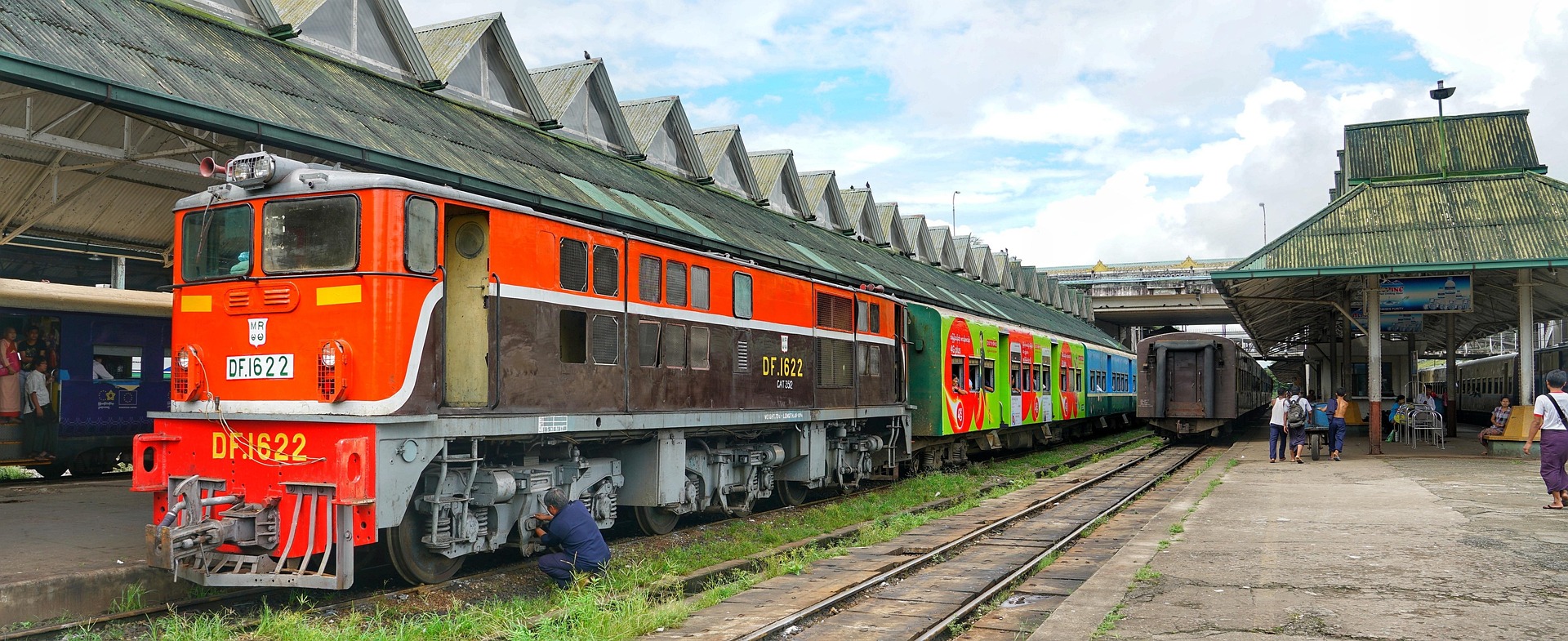 Scenic railway journey through the Myanmar countryside.
🚂 Why Myanmar’s Railways Are Unique in 2026 & 2027
- The Gokteik Viaduct — Asia’s second highest railway bridge, built in 1900, crosses a 100m gorge in one of the world’s great engineering feats
- Trains still run through places with no road access — the only way in is by rail
- Myanmar’s railways are among the few remaining in Southeast Asia where passengers ride in wooden-floored carriages unchanged for decades
- Visa-free entry for Russian citizens (30 days) and expanding international access makes 2026–27 the ideal window to visit
- Tourism numbers remain well below pre-2020 levels — key sites are uncrowded and truly unspoilt
- The Gokteik route from Mandalay to Pyin Oo Lwin is now bookable with private carriage upgrades through Exotic Myanmar Travels
Myanmar’s Most Iconic Train Routes
Myanmar Railways operates over 5,400 km of track connecting the country from the delta in the south to the hills of Shan State in the north-east. Here are the routes that every rail traveller should know.
Mandalay to Pyin Oo Lwin & Gokteik
Mandalay → Pyin Oo Lwin → Nawnghkio → Kyaukme
The crown jewel of Myanmar rail travel. Board the morning express at Mandalay and watch the city give way to red-chilli fields as the train climbs steadily into the Shan Hills. At Pyin Oo Lwin — the cool, pine-scented former British hill station — the landscape shifts to strawberry farms and colonial-era architecture.
Then comes the moment every rail photographer dreams of: the train slows to a near-standstill as it edges across the Gokteik Viaduct — a 689-metre-long, 102-metre-high lattice-steel wonder built in Pennsylvania in 1900. The gorge below falls away into jungle, mist, and silence. It is genuinely one of the most breathtaking travel moments in Asia.
Yangon Circular Train
Yangon Central → full loop → Yangon Central
Not a destination but an immersive urban experience. The Yangon Circular Train makes a 46-km loop around the city in approximately 3 hours, stopping at 38 stations. It costs less than a dollar and offers an extraordinary window into Yangon’s daily life that no tourist attraction can match.
Watch vendors board with baskets of vegetables, flowers, and live chickens; see schoolchildren in white-and-green uniforms; observe factory workers, market traders, and monks on their daily rounds. The outer stations pass through garden allotments, suburban markets, and sleepy riverside communities rarely seen by visitors.
Mandalay to Naypyidaw to Bago
Mandalay → Naypyidaw → Bago → Yangon
The overnight express between Mandalay and Yangon — via the new capital Naypyidaw — is one of Myanmar’s great long-distance rail experiences. Reserve a sleeper cabin and fall asleep watching the lights of rural villages drift past your window, waking as the train descends to Yangon’s tropical delta.
The day train offers equally rewarding views: the vast dry-zone plains of Central Myanmar, the pagoda-crowned hills of Bago, and the lush greenery of the Pegu Range — a cross-section of Myanmar’s extraordinary geographical diversity.
Thazi to Shwenyaung (Inle Lake)
Thazi → Kalaw → Shwenyaung (Inle Lake)
An underrated classic: the slow train from the dusty junction town of Thazi climbs through the Shan Hills, stopping at the charming colonial hill station of Kalaw — famous for trekking through ethnic-minority villages — before descending to Shwenyaung, the gateway to Inle Lake.
The journey takes 6–8 hours and crosses some of Myanmar’s most spectacular highland scenery, including bamboo forests, terraced hillsides, and villages where Pa-O and Danu people live much as they have for centuries. A truly off-the-beaten-path rail experience.
The Gokteik Viaduct — Asia’s Most Dramatic Rail Crossing
No railway experience in Myanmar — or arguably in all of Southeast Asia — compares to crossing the Gokteik Viaduct. Commissioned by the British colonial government and completed in 1900 by the Pennsylvania Steel Company, this lattice-steel masterpiece stretches 689 metres across a breathtaking gorge in the Shan Hills, at a height of 102 metres.
When the train approaches the viaduct, it slows to walking pace. Passengers lean from windows and open doors; cameras click furiously; the world seems to hold its breath. Below, the gorge drops in layers of jungle, mist, and the distant silver thread of a stream. It is one of those rare travel moments that exceeds every expectation and lives permanently in memory.
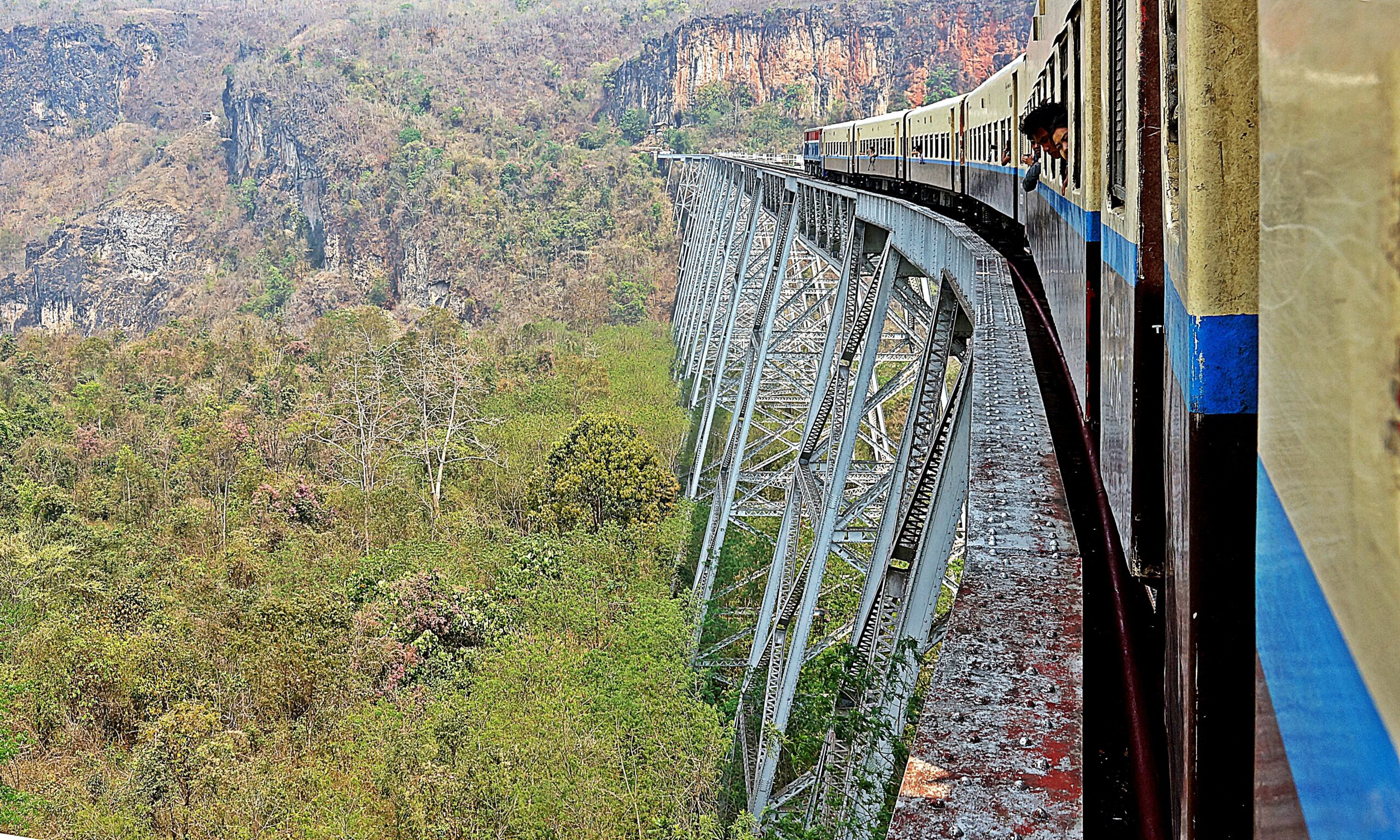 The historic lattice-steel Gokteik Viaduct towering over the valley.
🎯 Pro Photography Tip — Gokteik Viaduct
For the best photographs, board the train from Mandalay and sit on the right-hand side of the carriage (when facing the direction of travel toward Pyin Oo Lwin). The approach to the viaduct is from the west, so the right side has the widest views into the gorge. Morning trains offer better light. Bring a wide-angle lens and a telephoto: you’ll want both.
Gokteik Viaduct — Essential Facts
| Detail | Information |
|---|---|
| Location | Between Nawnghkio and Kyaukme, Shan State |
| Length | 689 metres (2,260 feet) |
| Height | 102 metres (335 feet) above the gorge floor |
| Built | 1900 by Pennsylvania Steel Company, USA |
| Train speed | Approximately 15–20 km/h (walking pace) when crossing |
| Train frequency | 2–3 trains daily each direction (Mandalay ↔ Lashio) |
| Best time | November–February (clear skies, mist in gorge); Oct & Mar also excellent |
| Booking | Upper Class tickets via Myanmar Railways or through Exotic Myanmar Travels |
The Yangon Circular Train — City Life in Slow Motion
While the Gokteik route draws photographers and adventurers, the Yangon Circular Train is beloved by anthropologists, street photographers, and anyone who wants to understand how Yangon’s 8 million residents actually live.
This 46-km loop, running on narrow-gauge tracks laid in the 1950s, passes through 38 stations over approximately 3 hours. The line encircles the city, passing through industrial zones, market districts, suburban townships, and quiet garden neighbourhoods that have changed little in decades.
At each station, the train fills with vendors selling mohinga soup, curry, tea, flowers, and fresh produce. At larger stations, entire market ecosystems appear on the platform — traders unloading goods, porters with enormous head-loads, and station masters in formal dress. It is, quite simply, the best value travel experience in all of Myanmar.
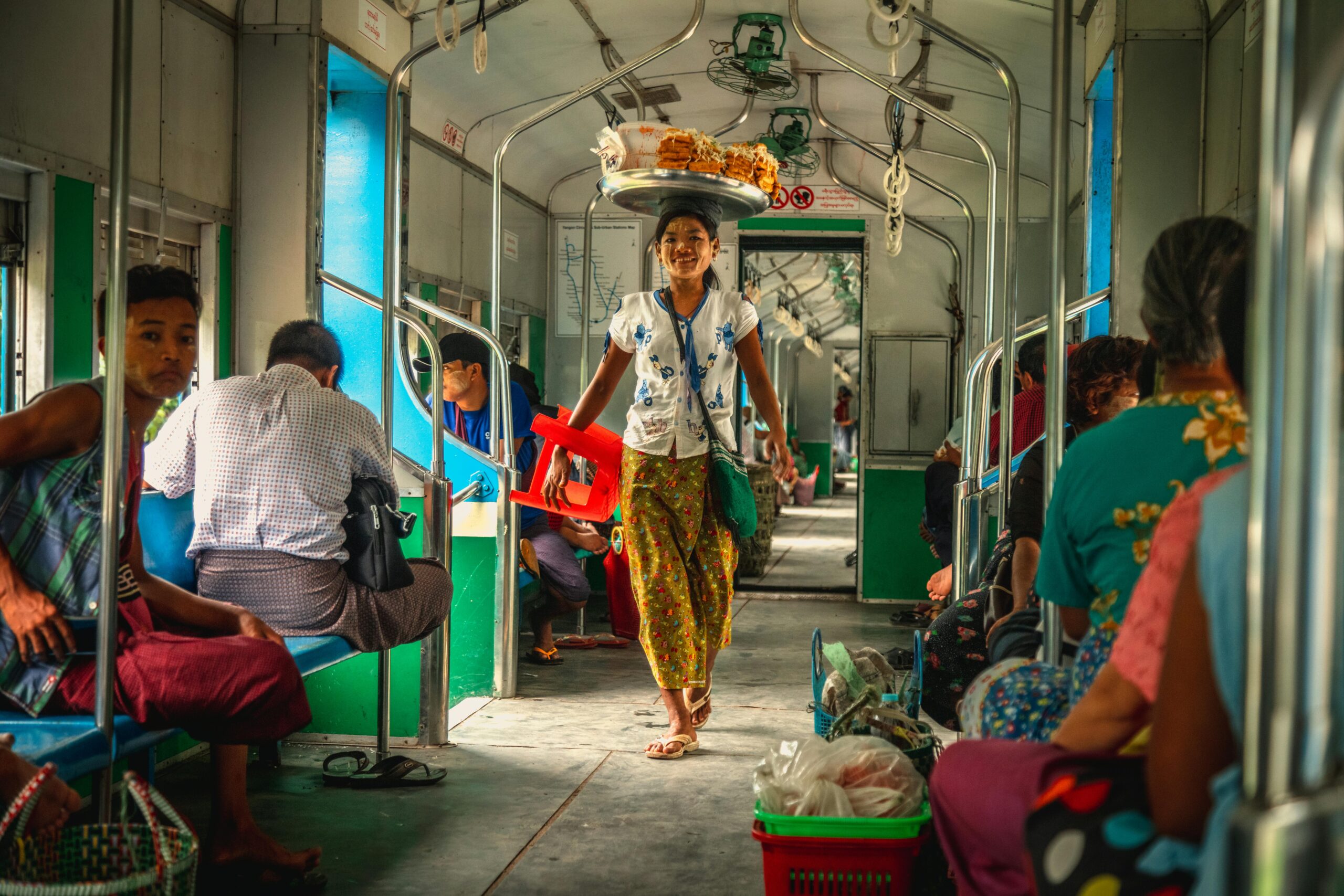 Vibrant human interactions and fresh produce markets on the Yangon loop.
🚉 Yangon Circular Train — Visitor’s Guide
Trains depart Yangon Central Station (near Sule Pagoda) from approximately 04:00 to 20:00, with departures roughly every 30 minutes. The full loop costs less than USD 1. For the best experience, board around 7:00–8:00 AM when the morning market vendors are most active, or at 3:00–4:00 PM for the homeward rush and golden-hour light through the carriage windows. Our guides can accompany you for full cultural context.
Sample Rail Journey: 10-Day Myanmar by Train
This curated itinerary combines Myanmar’s greatest train journeys with its most iconic cultural destinations — available as a private guided tour through Exotic Myanmar Travels & Tours.
Welcome to the Golden Land
Arrive in Yangon; private transfer to hotel. Evening visit to Shwedagon Pagoda at sunset — 98 metres of gold encrusted with 4,000+ diamonds and rubies, illuminated at dusk. Welcome dinner at a heritage restaurant.
The Circular Train Experience
Morning: Board the Yangon Circular Train for the full 3-hour loop — markets, monasteries, and city life. Afternoon: Colonial downtown walking tour — Strand Hotel, High Court, Bogyoke Market. Evening free.
Overnight Sleeper Express
Board the overnight Mandalay express at Yangon Central (departs ~15:30). Sleeper cabin; dinner on board or packed from Yangon. Fall asleep watching the delta countryside glide past. Wake up to the plains of Upper Myanmar.
Royal Mandalay & U Bein Bridge
Arrive Mandalay in the morning. Mandalay Palace, Kuthodaw Pagoda (world’s largest book), gold-leaf workshops. Afternoon: U Bein Bridge at Amarapura for sunset — the world’s longest teak footbridge over Taungthaman Lake.
Mandalay to Pyin Oo Lwin — Gokteik Viaduct
The highlight of the journey: board the morning train at Mandalay Central. Climb through the Shan Hills to Pyin Oo Lwin — colonial hill station with botanical gardens and strawberry farms. Cross the legendary Gokteik Viaduct at sunset pace. Overnight Nawnghkio or continue to Hsipaw.
Hsipaw or Kyaukme — Shan Village Life
Explore Hsipaw: Shan Palace, local market, optional riverside walk or village trek to Palaung communities. Return by afternoon train to Pyin Oo Lwin or Mandalay. Overnight Mandalay.
By Road Along the Irrawaddy
Private vehicle transfer to Bagan (~4–5 hrs) with optional Mount Popa detour. Arrive Bagan; first sunset over the temple plain — 2,000+ ancient pagodas blazing in amber and rose. Dinner at a local restaurant.
The Temple Plain — Bagan Archaeological Zone
Two full days exploring Bagan’s magnificent heritage: Ananda, Shwezigon, Dhammayangyi, Sulamani, Htilominlo. Sunrise e-bike ride. Optional hot-air balloon (Nov–Mar). Lacquerware workshop. Irrawaddy sunset cruise.
Fly Yangon — Farewell Myanmar
Domestic flight from Nyaung-U (Bagan) or Mandalay to Yangon for international connection. Last-minute shopping at Bogyoke Market. Warm farewell from your Exotic Myanmar Travels team.
Best Time to Travel by Train in Myanmar
Myanmar’s climate is broadly divided into three seasons. For train travel — especially the open-window experience of the Gokteik route — the dry, cool season is ideal.
Nov – Feb
Cool & dry. Crystal-clear mountain views, gorge mist at Gokteik, comfortable carriage temperatures. Peak season for rail photography.
Oct & Mar
Shoulder season. Still pleasant; landscapes lush from recent rains. Fewer tourists than peak. Gokteik misty and dramatic.
Apr – May
Very hot in lowlands; carriages without A/C can be uncomfortable. Bagan & Mandalay extremely warm. Shan Hills still pleasant.
Jun – Sep
Monsoon season. Lush, dramatic scenery. Rain delays possible. Gorge views may be obscured by heavy cloud. Not ideal for Gokteik.
Train Classes & Booking Tips
Myanmar Railways operates several classes of carriage on its long-distance routes. Understanding the options ensures you choose the right balance of comfort, authenticity, and access.
| Class | Description | Best For | Price (approx.) |
|---|---|---|---|
| Upper Class | Reclining seats, A/C on newer trains, fan on older; reserved seating; relatively spacious | Tourists; long-distance routes (Mandalay–Lashio, Mandalay–Yangon) | USD 10–25 depending on route |
| Ordinary Class | Wooden or padded seats; ceiling fans; crowded; full local atmosphere | Budget travellers; short routes; Yangon Circular Train | USD 1–8 depending on route |
| Sleeper Class | Berths (upper & lower); bedding provided; available on overnight Mandalay–Yangon express | Overnight journeys; saving hotel cost; romantic rail experience | USD 20–40 per berth |
| Private Carriage | Chartered carriage or compartment for private groups; available on select routes through tour operators | Families; photography groups; premium experience | Quoted on request |
📋 Booking Tips — 2026 & 2027
Book Upper Class tickets at least 3–5 days in advance for popular routes such as Mandalay–Pyin Oo Lwin and Mandalay–Yangon sleeper, especially during peak season (November–February). Tickets can be purchased at Myanmar Railways stations (Yangon Central, Mandalay Central), through licensed travel agents, or — most conveniently — through Exotic Myanmar Travels & Tours, who handle all bookings and transfers as part of your private tour package.
Essential Tips for Train Travel in Myanmar
🧳 What to Pack
Long-distance trains in Myanmar are not air-conditioned on most routes, so dress in light, breathable layers. For Shan Hills routes (Gokteik, Kalaw), bring a light jacket — temperatures can drop significantly at elevation. Bring snacks for longer journeys, though vendors at stations and on board usually provide fresh fruit, noodles, and tea. Pack a scarf or bandana: the tunnels send puffs of smoke into open carriages.
📸 Photography Etiquette
Myanmar’s train journeys are a photographer’s paradise — but always ask permission before photographing people at close range, especially monks and ethnic minority travellers. A smile and a gesture toward your camera is usually enough to get a nod or a delightful refusal. Platform vendors enjoy being photographed if you buy something from them first. The Gokteik crossing is completely open to photography — no restrictions.
🕐 Time & Punctuality
Myanmar trains operate on a flexible schedule. Delays are common — sometimes 1–2 hours on long routes — and are part of the charm rather than an inconvenience. Embrace the slow pace: a delay at a remote station often means more time to explore a village market or share tea with fellow passengers. Never plan a connecting flight on the same day as a long train journey.
🍜 Eating on the Train
One of the great pleasures of Myanmar rail travel is the food parade at every station. Vendors board at major stops offering mohinga (fish noodle soup — Myanmar’s national breakfast), shan noodles, samosas, tea-leaf salad, fresh-cut fruit, roasted corn, dried fish, and sweet pastries. Prices are tiny. Eating what the locals eat on a slow train through the countryside is one of Myanmar’s most authentic travel experiences.
Published by: Exotic Indochina Travels & Tours · Category: Myanmar Travel Guide · Tags: Myanmar Train, Gokteik Viaduct, Yangon Circular Train, Rail Travel Asia, Myanmar 2026, Myanmar 2027, Shan Hills, Mandalay, Burma by Rail